




Custom Software vs Off-the-Shelf Software: Which Is Better?
Choosing the right software can have a long-term impact on how efficiently a business operates. While off-the-shelf software provides ready-made features and faster deployment, custom software is designed around a company’s specific workflows and requirements.
So, which is better: custom software or off-the-shelf software? The answer depends on your business processes, budget, integration requirements, scalability needs, and long-term goals.
What Is Custom Software?
Custom software is developed specifically for a particular business or organization. Instead of adapting business processes to an existing product, the software is designed around the company’s workflows, users, data, and objectives.
For example, a company with a unique order-management process may need a system that connects its CRM, inventory, payment gateway, and internal operations in a specific way.
Benefits of Custom Software
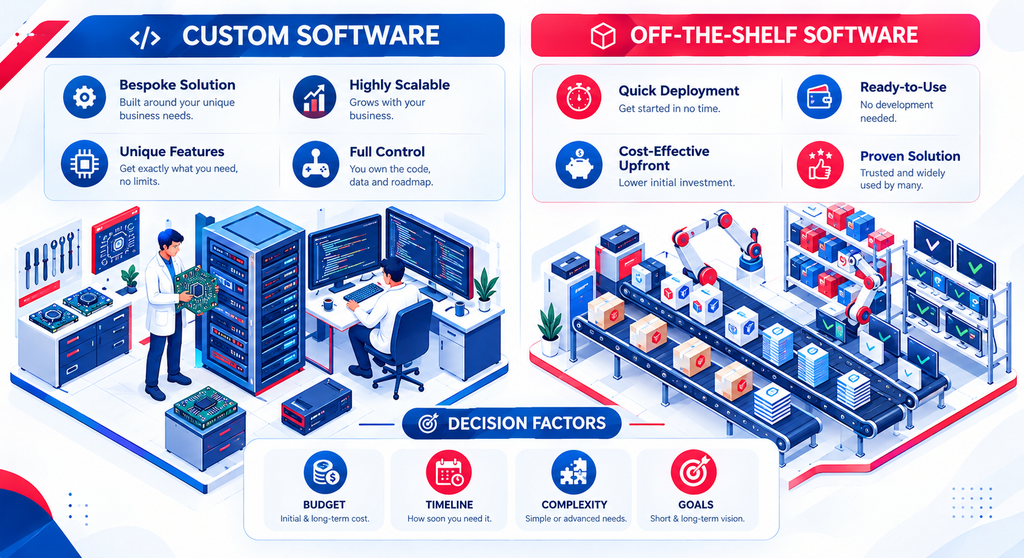
- Exact business fit: Features and workflows can be designed around actual requirements.
- Greater flexibility: New functionality can be added as the business evolves.
- Deep integrations: Custom APIs and integrations can connect multiple business systems.
- Scalability: Architecture can be planned around expected growth.
- Greater control: Businesses have more control over functionality, data, and future development.
The trade-off is that custom software generally requires more upfront investment, planning, development, testing, and ongoing maintenance.
What Is Off-the-Shelf Software?
Off-the-shelf software is a ready-made product developed for a broad market. Businesses typically subscribe to or purchase the product and configure the available features according to their needs.
Examples include common tools for accounting, CRM, communication, project management, payroll, and collaboration.
Benefits of Off-the-Shelf Software
- Faster implementation
- Lower initial investment
- Proven features
- Vendor-managed updates and maintenance
- Easier access to established support
However, businesses may need to adjust their processes to match the software. Customization and integrations can also be limited by what the vendor supports.
Custom Software vs Off-the-Shelf: Key Differences
| Factor | Custom Software | Off-the-Shelf Software |
|---|---|---|
| Initial cost | Usually higher | Usually lower |
| Deployment | Takes longer | Faster |
| Customization | Very high | Limited to available options |
| Business fit | Designed for your workflows | Designed for a broad market |
| Integration | Can be built around your systems | Depends on available integrations |
| Scalability | Designed around business requirements | Depends on vendor and product |
| Maintenance | Business/development partner responsibility | Usually vendor-managed |
| Control | Greater control | Vendor controls product roadmap |
| Best for | Unique or strategic workflows | Standard business requirements |
Neither option is automatically better. The right choice depends on what your business actually needs.
When Should You Choose Off-the-Shelf Software?
Off-the-shelf software is often the better choice when your requirements are common and a reliable product already solves the problem.
Consider it when:
- You need to launch quickly.
- Your workflow closely matches existing software.
- Your budget is limited.
- You do not need extensive customization.
- The vendor provides the integrations you need.
- The software is not a core competitive differentiator.
For standard functions such as email, basic accounting, project management, or general CRM, buying an established product can be more practical than developing a new system.
When Does Custom Software Make More Sense?
Custom software becomes more attractive when existing products create significant limitations or workarounds.
Consider custom development when:
- Your workflows are highly specific.
- Existing software cannot provide essential functionality.
- Multiple systems need deep integration.
- You need a highly tailored user experience.
- The software supports a strategically important business process.
- Your organization expects significant growth.
- You require greater control over the technology and development roadmap.
A useful rule is simple: buy software when the problem is common; consider building when the problem is unique or strategically important.
Don’t Compare Only the Upfront Cost
One of the biggest mistakes businesses make is comparing only the initial purchase price with the cost of custom development.
Instead, consider the total cost of ownership (TCO), including:
- Subscription or licensing fees
- Implementation
- Customization
- Integration
- Training
- Maintenance
- Support
- Additional user or feature costs
- Internal productivity lost to inefficient workflows
An inexpensive product can become less attractive if employees constantly need workarounds. Similarly, custom development may not make financial sense when an established product already solves the problem effectively.
What About a Hybrid Approach?
Businesses do not always have to choose one approach exclusively.
A hybrid strategy can combine established software for standard processes with custom applications or integrations for unique business requirements. This approach can provide the speed of ready-made software while allowing businesses to customize the areas that create the most value.
Final Verdict
So, custom software vs off-the-shelf software—which is better?
There is no universal winner.
Choose off-the-shelf software when speed, lower initial investment, and standard functionality are the priorities. Choose custom software when unique workflows, deep integrations, flexibility, and long-term control are more important.
Before making a decision, evaluate your current processes, future growth, integration requirements, total cost, and the strategic importance of the software.
For businesses with unique operational requirements, working with an experienced software development partner can help turn those requirements into a scalable technology solution.