





AI Agents vs Chatbots: What’s the Difference?
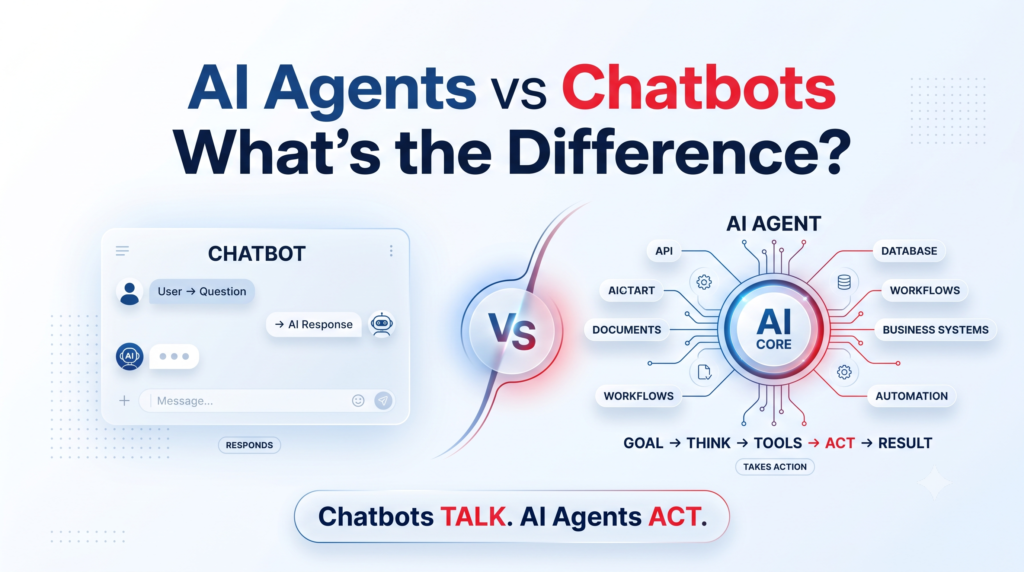
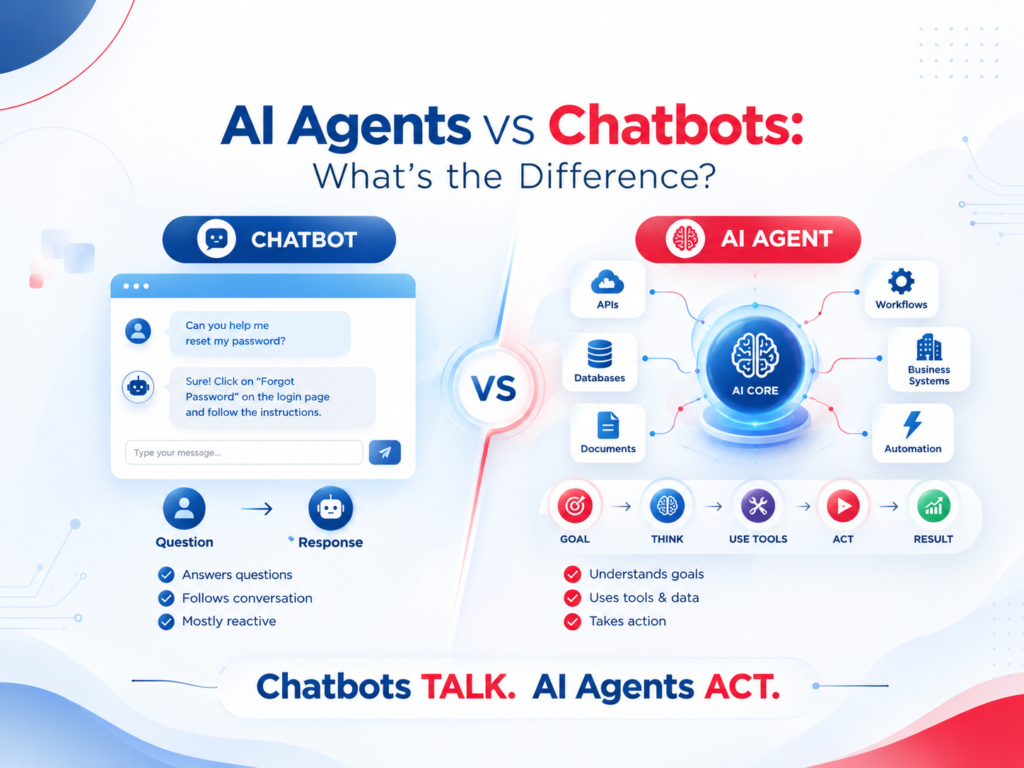
AI-powered customer experiences are moving beyond simple question-and-answer systems. While chatbots have become common for customer support and information sharing, AI agents are designed to go further by reasoning through tasks, using tools, and taking actions.
So, when comparing AI agents vs chatbots, what is the actual difference?
In simple terms, a chatbot primarily talks with users, while an AI agent can understand a goal, decide what needs to happen, and take actions across connected systems. The right choice depends on the complexity of the business problem you want to solve.
What Is a Chatbot?
A chatbot is a software application designed to communicate with users through text or voice.
Traditional chatbots often rely on predefined rules, decision trees, or scripted responses. Modern AI chatbots can use large language models (LLMs) to understand natural language and generate more flexible responses.
For example, a customer might ask:
“What are your business hours?”
A chatbot can understand the question and provide the relevant information.
Chatbots are particularly useful for:
- Answering frequently asked questions
- Providing product information
- Guiding website visitors
- Basic customer support
- Collecting initial customer information
- Routing users to the appropriate department
They are primarily conversation-focused systems.
What Is an AI Agent?
An AI agent is designed to achieve a goal by understanding context, reasoning about what needs to happen, and taking actions through connected tools or systems.
Microsoft describes AI agents as systems that can perceive their environment, make decisions, and take actions toward specific goals. Unlike conventional chatbots, agents can handle complex, multi-step tasks across systems.
For example, instead of simply answering:
“Can I get a refund?”
an AI agent could potentially:
- Verify the customer’s order.
- Check the refund policy.
- Confirm eligibility.
- Submit the refund request.
- Update the relevant system.
- Notify the customer.
The exact capabilities depend on the agent’s permissions, integrations, tools, and business rules.
AI Agents vs Chatbots: Key Differences
| Feature | Chatbot | AI Agent |
|---|---|---|
| Primary purpose | Conversation | Goal completion |
| Interaction | Mostly question and answer | Conversation + action |
| Autonomy | Usually limited | Can be higher |
| Reasoning | Basic to advanced | Designed for multi-step reasoning |
| Tool usage | Limited or predefined | Can use connected tools |
| System integration | Often limited | Can work across multiple systems |
| Workflow execution | Usually low | Stronger |
| Best suited for | FAQs and support | Complex business processes |
The biggest distinction is action.
A chatbot may tell you what to do. An AI agent can potentially do it for you.
How AI Agents and Chatbots Work Together
The choice does not always have to be AI agents vs chatbots.
Businesses can use both.
For example, a customer-service system might begin with a chatbot that handles common questions. When the request requires a complex action, it can hand the task to an AI agent.
A simplified workflow could look like:
Customer → Chatbot → Understand Request → AI Agent → Business Systems → Action → Customer
This approach allows the conversational layer and action layer to work together.
When Should a Business Use a Chatbot?
A chatbot is often the better choice when the primary requirement is communication.
Consider a chatbot if you need:
- Website FAQ support
- Basic customer service
- Lead qualification
- Product information
- Appointment guidance
- Website navigation
- 24/7 basic assistance
If most customer questions can be answered from a knowledge base, a chatbot may provide enough value without the additional complexity of an agent.
When Should a Business Use an AI Agent?
AI agents become more relevant when the system needs to perform tasks rather than simply provide information.
Examples include:
Customer Service
An agent could potentially check an order, update a support ticket, and provide the customer with a status update.
Sales Operations
An agent could qualify leads, update CRM records, schedule meetings, and trigger follow-up workflows.
Internal Operations
An agent could retrieve information from company systems, summarize documents, and initiate approved workflows.
Finance and Administration
With appropriate controls, agents can assist with tasks such as invoice processing, reconciliation workflows, or reporting.
Enterprise Workflows
Agents can be connected to APIs, databases, business applications, and internal knowledge systems to coordinate multi-step processes.
The Business Value of AI Agents
The biggest opportunity with AI agents is not simply having a smarter chatbot.
It is connecting intelligence with execution.
A conventional chatbot might answer:
“Your invoice is overdue.”
An appropriately designed agent could potentially check the invoice record, identify the customer, retrieve payment information, initiate an approved reminder workflow, and update the CRM.
This is why AI agents are particularly relevant to organizations looking to automate operational workflows.
However, autonomy should always be matched with appropriate permissions, monitoring, security, and human oversight. Microsoft also highlights governance, transparency, and human oversight as important considerations for responsible agent deployment.
How BWJ Tech Solutions Approaches AI Agents
AI agents are closely aligned with BWJ Tech Solutions’ AI Transformation services.
BWJ currently describes its AI capabilities around LLM and agentic integration, predictive analytics, natural-language understanding, RAG, private-cloud LLM deployment, and AI workflow transformation.
This is important because implementing an AI agent is not simply about connecting a chatbot to an LLM.
A production-ready business agent may require:
- Secure API integrations
- Business rules
- Data access controls
- RAG or knowledge retrieval
- Tool orchestration
- Authentication
- Logging and monitoring
- Human approval workflows
- Scalable infrastructure
BWJ’s Custom Software service also focuses on scalable enterprise applications, microservices, cloud-native systems, and real-time data processing—capabilities that can support complex agentic workflows.
Final Takeaway
AI agents and chatbots may look similar, but they serve different purposes. Chatbots are mainly designed to communicate and provide answers, while AI agents are built to understand goals, make decisions, use tools, and complete tasks.
For simple customer questions, FAQs, and basic support, a chatbot may be enough. For complex business processes that require automation, system integrations, and multi-step actions, AI agents can provide greater value.
The future is not necessarily about choosing one over the other. Businesses can combine both—using chatbots to handle conversations and AI agents to turn those conversations into meaningful actions.
In simple terms: Chatbots handle the conversation. AI agents handle the work.