
Most businesses rely on several software applications to manage their daily operations. One system handles customer information, another manages inventory, while separate applications take care of accounting, payments, and employee records.
The problem starts when these applications cannot communicate with each other. Employees may have to enter the same information multiple times, transfer data manually, or switch between different platforms to complete a simple task.
This is where REST API integration makes a difference. It helps different applications communicate with each other, share information, and work together without requiring businesses to replace their existing software.
What Is REST API Integration?
REST API integration is a way of connecting different software applications so they can exchange information.
REST stands for Representational State Transfer, while API stands for Application Programming Interface. In simple terms, an API acts as a bridge between two applications, allowing them to request and share information.
For example, imagine a customer places an order through an online store. The website can communicate with the inventory system to check product availability and send order details to the relevant application.
This communication can happen automatically through a REST API, without someone having to manually transfer the information.
REST APIs commonly use HTTP methods and exchange data in formats such as JSON, making them suitable for connecting applications built with different technologies.
How Does REST API Integration Work?
The process is quite straightforward. One application sends a request to another application through an API endpoint. The receiving application processes that request and sends back a response.
Let’s take a simple example of a website connected to a CRM system.
- A customer fills out a contact form on the website.
- The website sends the customer’s details to the CRM through an API request.
- The CRM receives the information and creates a new customer or lead record.
- The CRM sends a response confirming whether the operation was successful.
- The website can then display a confirmation message to the customer.
REST APIs commonly use the following HTTP methods:
- GET: Retrieves information from another application.
- POST: Sends information or creates a new record.
- PUT: Updates or replaces an existing record.
- PATCH: Updates specific details of a record.
- DELETE: Removes a record.
These methods allow applications to communicate through a consistent set of operations.
How Businesses Use REST API Integration
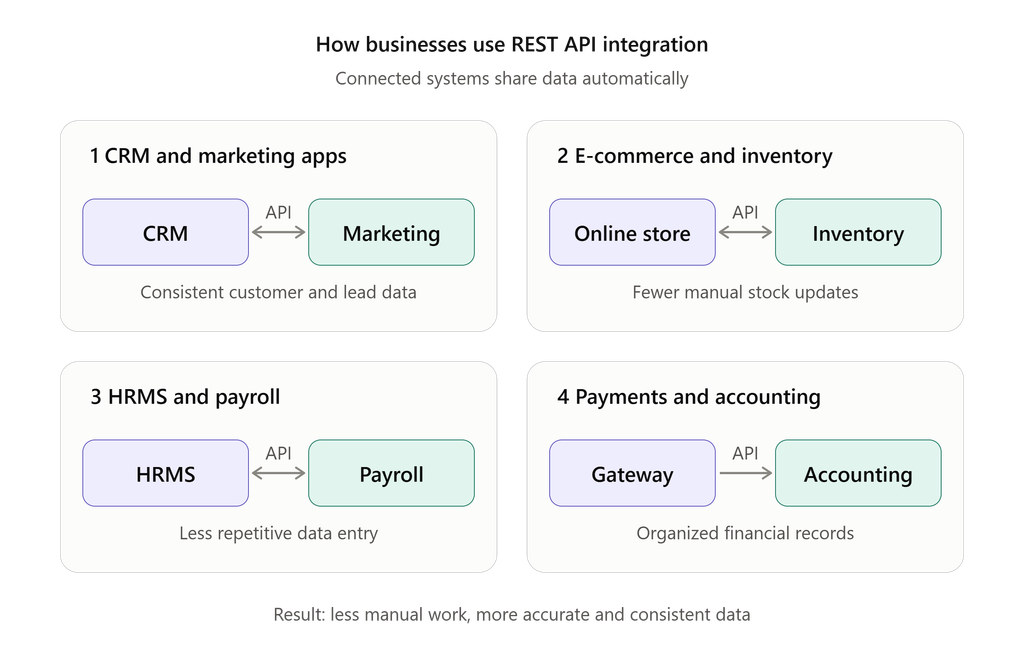
REST API integration is useful in many everyday business operations. Here are a few examples of how it works in practice.
1. Connecting CRM with Marketing Applications
Businesses often use separate tools for customer management and marketing campaigns. Connecting these applications allows customer details, leads, and campaign information to move between systems.
This helps sales and marketing teams work with more consistent customer information.
2. Connecting E-commerce with Inventory Management
An online store needs accurate product and stock information. When the store is connected to an inventory management system, product availability and order details can be exchanged automatically.
This reduces manual updates and helps businesses manage orders more efficiently.
3. Connecting HRMS with Payroll Software
Employee attendance, working hours, and salary information are often managed through different systems.
REST API integration can help transfer relevant employee and attendance data between HRMS and payroll applications, reducing repetitive data entry.
4. Connecting Payment Gateways with Accounting Software
After a customer makes an online payment, transaction details and payment status may need to be recorded in the accounting system.
An API connection can help transfer this information, making financial record management easier and more organized.
Benefits of REST API Integration for Businesses
When business applications work together, everyday operations become easier to manage.
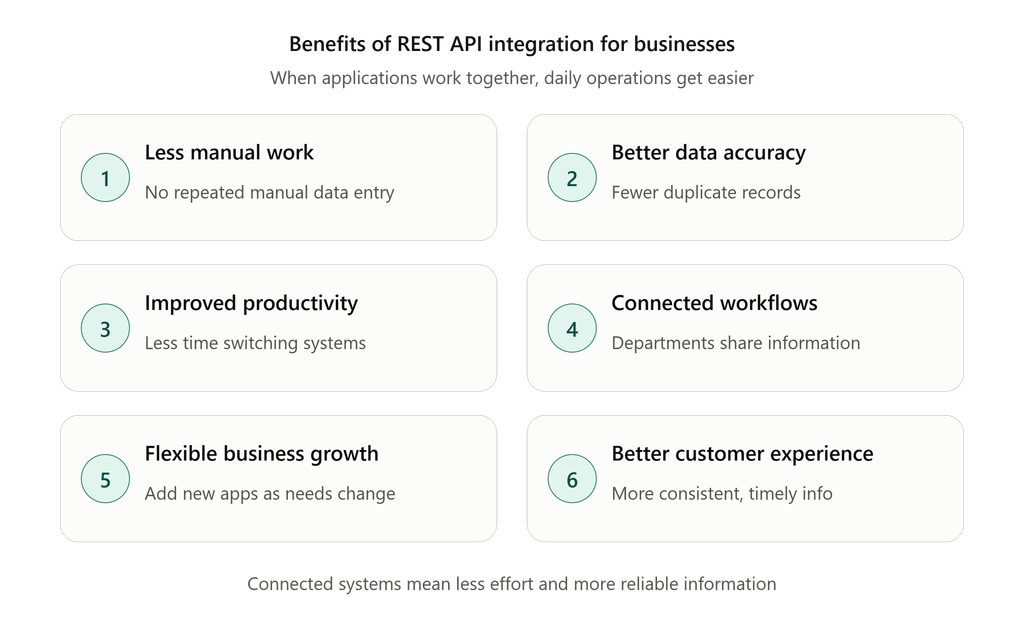
Some important benefits include:
- Less Manual Work: Information can move between applications without repeated manual entry.
- Better Data Accuracy: Reduces the chances of duplicate records and inconsistent information.
- Improved Productivity: Employees spend less time switching between systems and transferring data.
- Connected Workflows: Different departments can work with information shared across applications.
- Flexible Business Growth: New applications can be connected as business requirements change.
- Better Customer Experience: Connected systems help provide more consistent and timely information.
Common Challenges in REST API Integration
Although API integration offers several advantages, connecting different applications requires careful planning.
One common challenge is data compatibility. Two applications may store the same information in different formats, so the integration needs to handle those differences correctly.
Security is another important consideration. APIs may exchange sensitive customer, financial, or employee information. Proper authentication, authorization, HTTPS communication, and input validation are essential.
Businesses should also consider API request limits, application downtime, error handling, and ongoing maintenance. If one connected application changes its API, the integration may need to be updated as well.
Best Practices for Successful API Integration
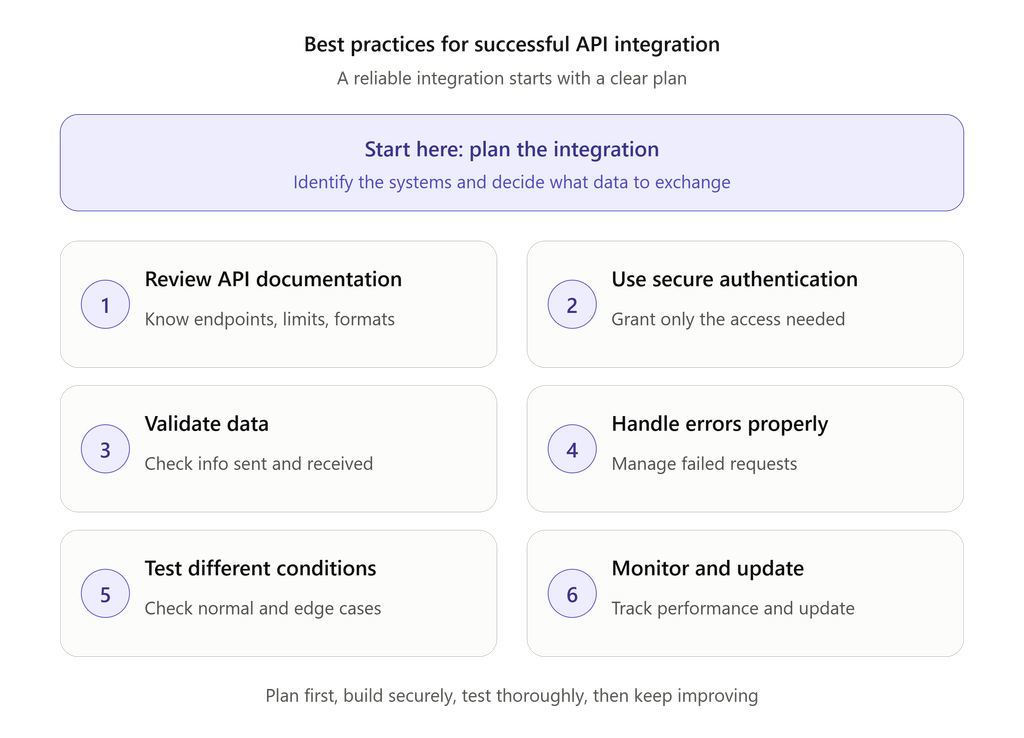
A reliable integration starts with understanding how the business applications need to work together.
Before development begins, identify the systems that need to communicate and decide what information should be exchanged.
It is also important to:
- Review the API documentation of each application.
- Use secure authentication and appropriate access permissions.
- Validate information before sending or receiving it.
- Handle errors and failed requests properly.
- Test the integration under different conditions.
- Monitor API performance and update integrations when required.
These steps help create integrations that are easier to maintain as business requirements evolve.
Conclusion
Businesses do not always need more software to improve their operations. Sometimes, they simply need their existing applications to work together.
REST API integration makes this possible by connecting different systems and allowing them to exchange information. Whether it is connecting a CRM with marketing software, an online store with inventory management, or HRMS with payroll, APIs help reduce manual work and create smoother business workflows.
At BWJ Tech Solutions, we understand the importance of building software that works around real business requirements. Our software development and custom business solutions can help businesses build connected applications and improve their digital operations.
Looking to connect your business applications? Visit BWJ Tech Solutions to explore how the right software solution can support your business.